

Alina Blackbriar
Alina is practical, wary, and considerably more stubborn than circumstances have any right to expect.
At twenty-one, she has little use for optimism. Life in Aurelion’s Fringe has taught her to trust what is in front of her, prepare for what is coming, and never assume luck intends to intervene on her behalf.
She is cautious without being timid.
Quiet without being meek.
Afraid without being helpless.
Alina knows fear intimately enough that she does not waste time pretending it is something else. She feels it. Accounts for it. And keeps thinking anyway.
There is a sharpness to her beneath the caution.
An irritation with self-pity.
A temper she knows when to swallow.
A small, deeply stubborn streak that survives even when expressing it would be unwise.
She is observant because attention matters. Practical because practicality keeps people alive. And skeptical of anything that sounds too much like hope.
Alina does not expect the world to make room for her.
She expects to find whatever space remains and make do with it.

Cassian Hyegrove
Cassian Hyegrove is difficult to impress and harder to unsettle.
He is precise, private, dryly funny, and relentlessly competent. He has little patience for ceremony, wasted effort, or problems that should have been solved before they reached his desk.
Order makes sense to him.
People are less cooperative.
Cassian notices more than he says and says considerably less than most people would like. He has the kind of confidence that does not ask to be admired and the kind of authority that rarely needs to announce itself.
He is not particularly interested in spectacle.
He prefers useful work, clear answers, and decisions that actually accomplish something.
He is also stubborn, sarcastic, occasionally insufferable, and much more entertaining than he first appears.
There is a great deal about Cassian that he does not volunteer.
You will have to earn the rest.

Levi Eventide
Levi is composed enough to make stillness feel deliberate.
Reserved, observant, intelligent, and self-contained, he has very little interest in drawing attention to himself and even less interest in performing for people who already intend to watch him.
He is not shy.
He simply does not see the point in unnecessary noise.
Levi possesses an unusual kind of confidence: settled rather than displayed. He rarely seems hurried, rarely wastes words, and carries himself with the ease of someone perfectly comfortable allowing silence to remain unanswered.
He watches before he participates.
Listens before he speaks.
And tends to regard a room as something worth understanding before deciding whether it deserves anything from him.
He is courteous when courtesy is warranted, but formality alone will not impress him. Status does not appear to either.
Respect, however, is another matter.
That he gives deliberately.
Balam is his Animora companion.
Levi does not seem particularly interested in explaining himself.
He is perfectly comfortable letting you wonder.

marial
Marial has the kind of calm that makes a room feel less complicated.
She is warm without being intrusive, composed without being distant, and practical enough to make kindness feel like something reliable rather than decorative.
Marial pays attention.
Not loudly.
Not in a way that makes someone feel examined.
She simply notices what is needed and adjusts.
She gives people space to answer in their own time. Explains what comes next before expecting anyone to follow. Corrects without humiliating. Reassures without making a performance of it.
As a Senior Attendant within Hyegrove, Marial carries herself with the ease of someone who knows exactly how the Household works and does not need to prove it.
There is structure in everything she does.
So is patience.
She is gentle, but never vague.
Kind, but never careless.
And when she tells someone they will not be left to figure things out alone, she sounds like the sort of person who means exactly that.
Marial does not demand trust.
She simply makes it easier to offer.

Diego
Diego has very little reverence for dignity.
Especially other people’s.
He is irreverent, sociable, shamelessly familiar, and possessed of the kind of confidence that treats rank as useful information rather than a reason to behave differently.
Formality rarely survives prolonged contact with him.
Diego is comfortable almost anywhere. He has an easy way of occupying space that suggests he has never once wondered whether he belongs there. Conversation comes naturally. So does teasing. And if an opportunity presents itself to make an otherwise serious situation considerably less serious, he is unlikely to let it pass unattended.
He is Cassian’s professional shadow.
This designation appears to grant him several privileges Diego has almost certainly granted himself.
Most notably, the freedom to call the Lord of Hyegrove Cas, ignore attempts to dismiss him, and treat the considerable machinery of Cassian’s authority as though it were mostly an unfortunate inconvenience surrounding his friend.
Diego is playful without being foolish.
Casual without being careless.
There is a sharp awareness beneath the ease, even when he appears to be paying attention to absolutely nothing of consequence.
But solemnity is not his natural state.
Diego likes people.
He likes conversation.
He likes provoking reactions purely because they are available to be provoked.
And he seems to regard excessive seriousness as a condition requiring immediate intervention.
There are people who enter a room and accommodate its atmosphere.
Diego tends to alter it.
Usually without asking permission.

calder
Calder is difficult to make formal.
He is easygoing, intelligent, direct, and entirely unimpressed by the distance a title is supposed to create between two people.
Which is convenient, because he dislikes titles anyway.
Calder is the doctor that runs Hyegrove’s infirmary, but there is very little ceremony about him. He carries competence lightly. The knowledge is there. The authority is there. He simply has no particular interest in making either one intimidating.
There is an openness to Calder that feels immediate.
He is approachable without being overeager.
Casual without being careless.
Gentle without treating anyone as fragile.
He has an instinct for meeting people where they are rather than where he thinks they ought to be, and an unusual comfort with allowing silence to exist when someone needs it.
Calder is also refreshingly irreverent.
His first name is apparently negotiable.
“Doctor” is exhausting.
And “Cal” is reserved, according to him, for “very special assholes.”
There is very little performance in Calder.
What you see is largely what you get: warmth, intelligence, an easy manner, and a man who would much rather make someone comfortable than remind them how important he is.
You can call him Cal.
He prefers it that way.

The fringe
The Fringe has been falling apart for a very long time.
It has simply never considered that a reason to stop.
There is something restless about it.
Something crowded and sharp-elbowed and perpetually in motion.
The Fringe wakes early.
It bargains.
Hauls.
Sells.
Scrounges.
Fights for another day of work because another day is still another day.
The Fringe wears its damage openly. There is no polished surface pretending the cracks are not there, and no embarrassment about what people do when there is not enough to go around.
It understands transactions.
Debts.
Favors.
What something is worth today and what someone might be willing to do for it tomorrow.
Everyone seems to have something to sell.
Sometimes it is labor.
Sometimes information.
Sometimes something considerably less comfortable to name.
And then night comes.
The district draws its elbows in and becomes something warier than it was beneath the sun.
The Fringe may be bruised.
It may be hungry.
But it has become remarkably good at surviving on what everyone else was willing to leave behind.
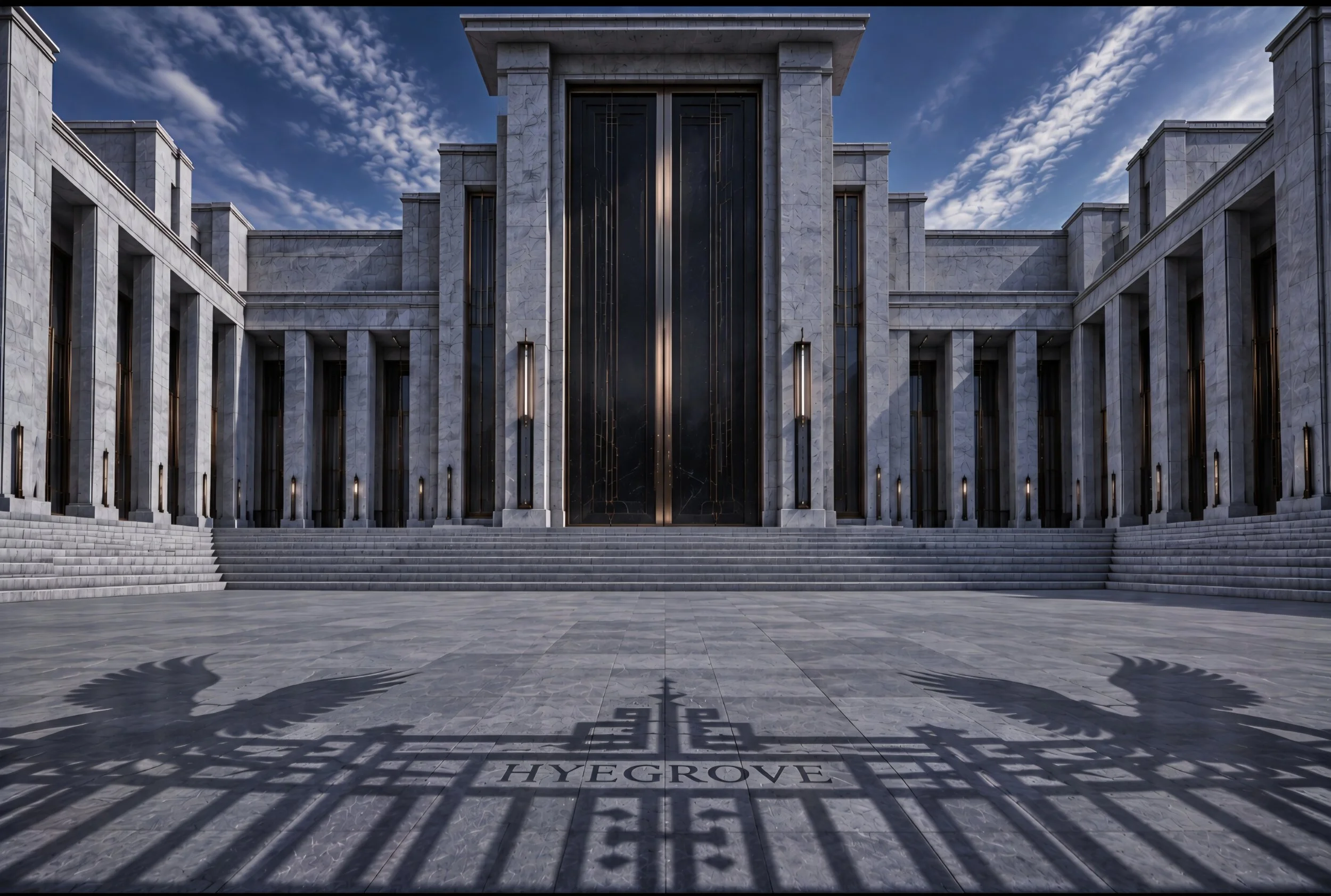
Hyegrove Estate
Hyegrove does not welcome.
It receives.
There is a difference.
The Estate carries itself with the composure of something entirely accustomed to being obeyed.
Nothing is hurried.
Nothing is careless.
Nothing appears to happen by accident.
Hyegrove does not need to remind anyone of its importance. It simply assumes the room will adjust.
And somehow, it does.
There is discipline in everything here.
In the silence.
In the rhythm of the Household.
In the way people seem to know where they belong before anyone has to tell them.
Hyegrove is not unfriendly.
That would require considerably more emotion than it seems willing to spend.
It is precise.
Reserved.
Immaculate.
The kind of place that makes disorder feel almost embarrassing.
It does not perform grandeur.
It considers grandeur the natural state of things.
And the longer you remain inside it, the more difficult it becomes not to straighten your posture.
Lower your voice.
Pay attention.
Hyegrove never asks for respect.
It behaves as though you arrived carrying it already.
Blackbriar Estate
Blackbriar does not feel abandoned.
It feels withdrawn.
There is a difference.
It has the unsettling composure of something that has spent a very long time being left alone and discovered it prefers the arrangement.
Nothing about Blackbriar seems eager to be found.
It does not announce itself.
Does not perform its importance.
Does not seem particularly concerned with whether anyone understands what it is.
And yet, it does not feel neglected.
Not dead.
Not waiting to be rescued.
Blackbriar is self-contained.
Private.
Watchful.
There is age here without frailty. Quiet without emptiness. Authority without spectacle.
The longer you remain, the harder it becomes to think of the Estate as forgotten.
Forgotten things decay.
Blackbriar simply kept going.
There is something almost unnerving about that certainty.
The sense that its absence never diminished it.
That being unseen and being gone were never the same thing.
Blackbriar does not feel like a place that was lost.
It feels like a place that chose not to be found.

xuri
Xuri is curious before she is cautious.
But only just.
She approaches the unfamiliar with her nose first, pausing long enough to decide what she thinks before committing herself one way or the other.
Once she has decided, however, subtlety appears to be optional.
Xuri is Alina’s Animora companion.
There is an immediate brightness to her. She chatters when pleased, investigates freely, and seems perfectly capable of treating a room full of strangers as something worth examining rather than something worth fearing.
That does not mean everyone receives automatic approval.
Xuri assesses.
She sniffs.
She considers.
And, if necessary, makes her reservations perfectly clear.
Acceptance is considerably more enthusiastic.
A cautious inspection can become a head-butt.
A moment of uncertainty can end with her wedging herself into whatever space she has decided belongs to her.
There is confidence in that affection.
No ceremony.
No hesitation once the choice has been made.
Xuri may take a moment to decide whether she trusts you.
She does not take nearly as long to decide where she intends to sit.

Arden
Arden is quiet in the way something ancient can afford to be.
She does not compete for attention.
She does not need to.
There is an unnerving awareness to her, the sense that Arden is paying attention to considerably more than whatever happens to be directly in front of her.
A shift in the air.
A sound no one else heard.
The smallest change in someone she knows well.
Arden notices.
And when she reacts, it is difficult not to pay attention.
She is watchful without being restless.
Steady without being passive.
There is gravity to her presence, but very little drama. Arden does not seem inclined to waste alarm on things that do not deserve it.
Even concern arrives quietly.
A step closer.
A held gaze.
A presence offered rather than imposed.
There is intelligence in her.
Patience.
And the unmistakable impression that whatever Arden is looking at, she is probably seeing more of it than you are.

balam
Balam does not need to announce himself.
He is already watching.
There is a patience to him that feels deliberate rather than passive. He observes first, allowing whatever has caught his attention to become interesting on its own terms.
Balam is Levi’s Animora companion.
Their bond requires very little ceremony. A shift in Balam’s attention can register as clearly as a change in pressure, carrying an impression without anything needing to be spoken aloud.
And Balam is curious.
Not restless.
Not easily alarmed.
Curious in the particular way of something intelligent enough to know that the unusual deserves another look.
He seems perfectly comfortable remaining silent while he decides what he thinks.
Which has the unfortunate effect of making his attention feel considerably louder.
Balam watches.
Balam considers.
And when those glowing green eyes settle on something—
it is difficult not to wonder what he has already noticed.